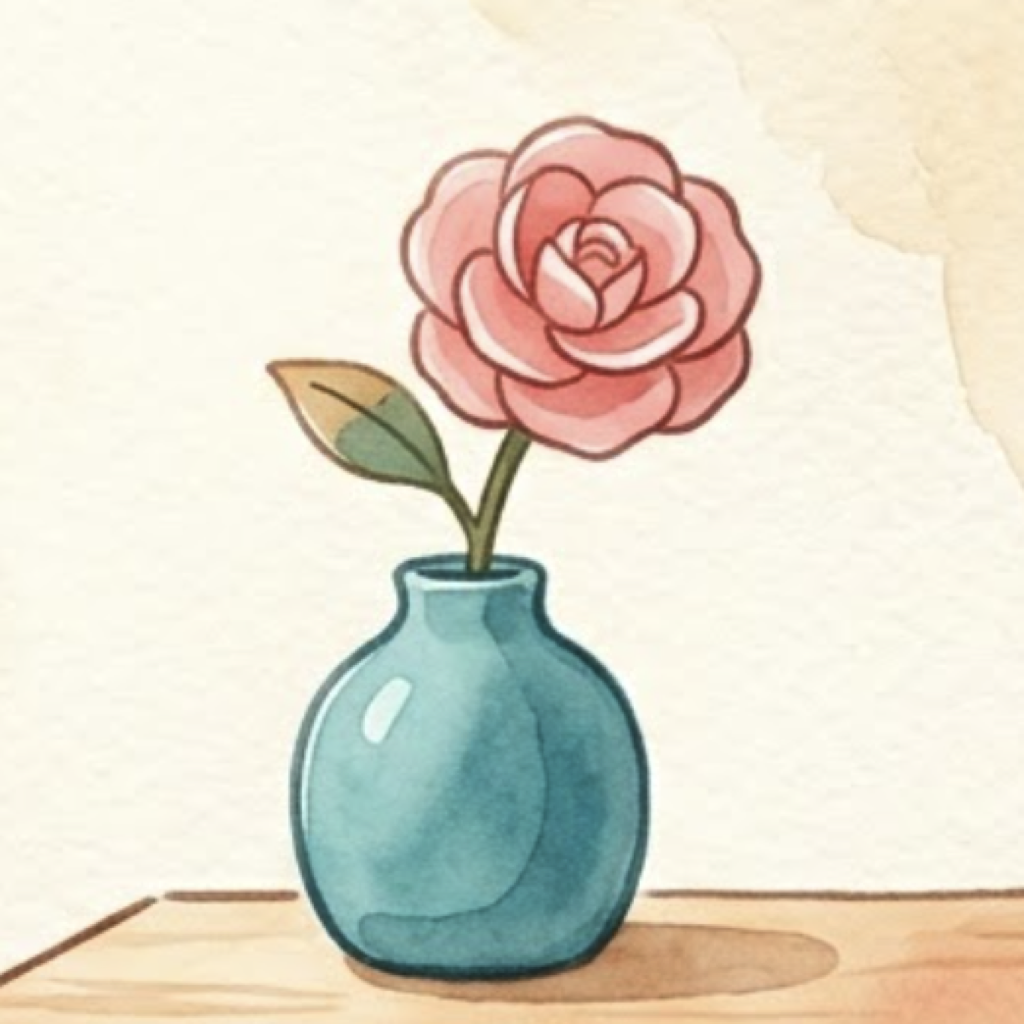
Dahlia pinnata
Dahlia Meaning: Dignity, Lasting Bonds, and Mexico's Geometric Marvel
July 25, 2026 · 3 min read
The dahlia looks engineered. Petals spiral out from the center in near-perfect mathematical order — florists' shorthand for the fanciest forms is literally "dinnerplate" — and the color range runs from blush to near-black with almost nothing off the menu. It is the showpiece of late summer, blooming bigger and bolder just as everything else in the garden starts writing its farewell note. Which is exactly where its meaning comes from: the dahlia is the flower of holding steady, splendidly.
What the dahlia symbolizes
The core meanings are dignity, elegance, commitment, and inner strength. The Victorians read the dahlia as dignity and forever thine — a flower for bonds meant to last — and its habit of peaking in September, thriving on the edge of the frost, added standing strong through change. The modern reading follows: dahlias are for lasting devotion between two people, which is why they've quietly become a wedding-flower heavyweight.
A useful nuance by tone: pale dahlias lean grace, the saturated jewel colors lean strength and drama, and the near-black varieties (deep burgundy, in truth — a "black dahlia" is very dark red) carry a fashionable edge of mystery.
Mexico's national flower
The dahlia is Mexican, and anciently so. The Aztecs knew it as acocoxochitl — "water-pipe flower," for its hollow stems, which were genuinely used to carry water — and grew it for food, ceremony, and medicine long before any European saw one. The tubers are edible; the empire that built floating gardens considered the dahlia partly a crop.
Seeds and tubers reached Madrid's botanical garden in 1789, where the flower was named for the Swedish botanist Anders Dahl. Europe then lost its mind in an entirely characteristic way: by the 1840s, dahlia-breeding mania rivaled tulip fever, with thousands of named varieties and single tubers selling for absurd sums. Mexico made it official in 1963: the dahlia is the national flower of Mexico.
The geometry
Part of the dahlia's power is that your brain notices the math before you do. The florets spiral in Fibonacci patterns — the same seed-head geometry as the sunflower, but layered into three dimensions — and the "pompon" and "ball" forms achieve a symmetry so complete they look lathed. There are over 40 species and some 57,000 registered cultivars, from button-sized pompons to dinnerplates a foot across. No other garden flower offers that range; the dahlia is less a flower than a genre.
Late summer's main character
Dahlias start slowly, then own August, September, and October outright — and the cutting rule is pure dahlia: the more you cut, the more they bloom. A single plant can yield bouquets for weeks if you keep harvesting it, which makes the dahlia the rare flower that rewards generosity mechanically. (Cut them fully open, though — dahlias don't open further in the vase. More vase-craft in how to make flowers last longer.)
When to give dahlias
- For commitment: engagements, anniversaries, vow renewals — forever thine is the flower's oldest line.
- For someone standing strong through a hard season — the dahlia's September logic.
- For a graduation or promotion, where dignity-with-drama is the correct register.
- Anytime in late summer, when the dahlia is simply the best thing available.
The dahlia brings its geometry to Bloomette, our hand-painted flower studio for iPhone — spirals, dinnerplates, and its Aztec history in the Flower Corner. For the dahlia's chief rival in lush, see the peony.